How to Share the Current Drawing With an Outside Engineer Without Emailing Copies
Keep one current drawing in a folder your firm owns and give the outside engineer access to it, instead of sending copies that go stale or links that expire.

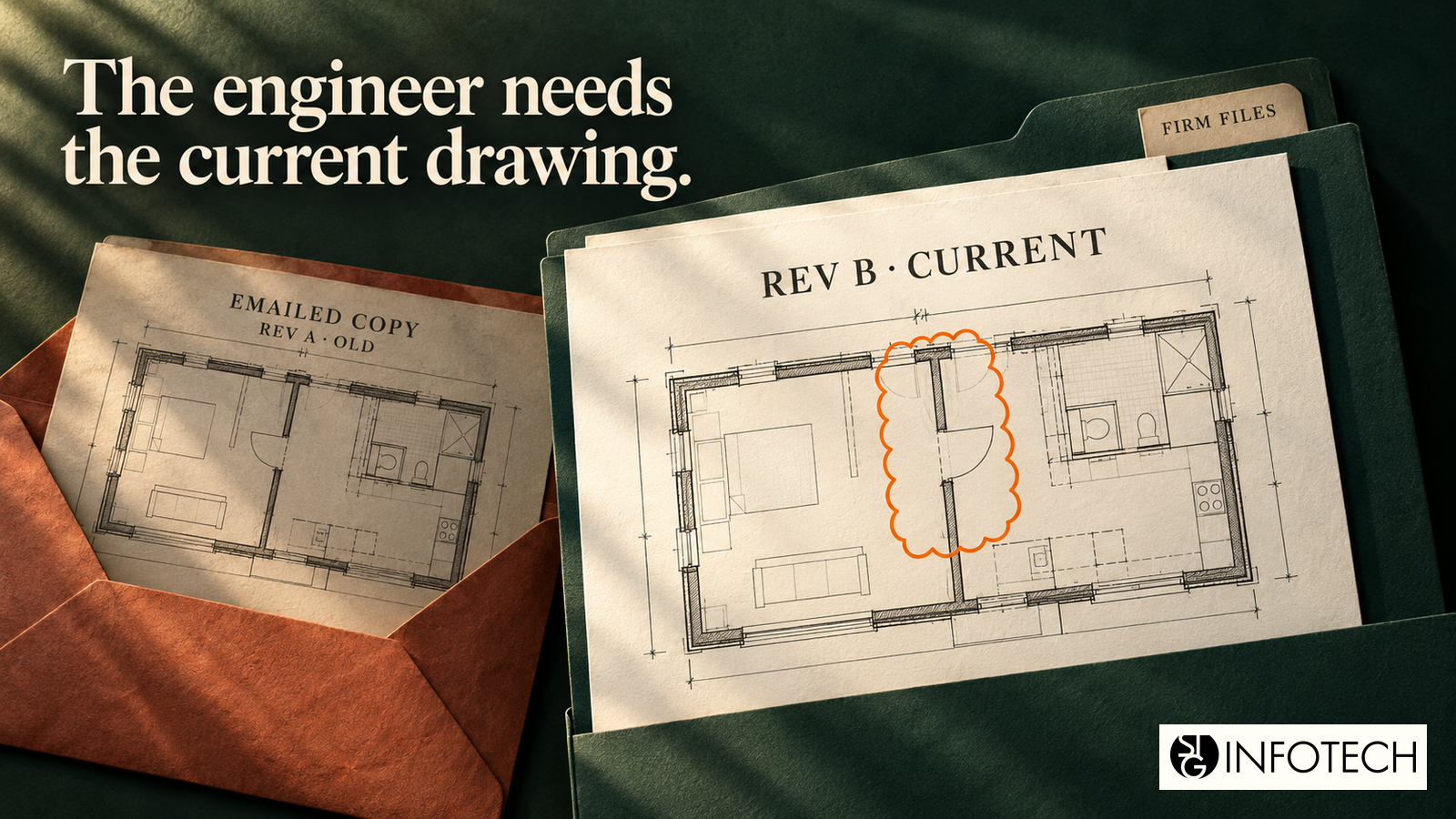
The short answer: keep one current drawing in a folder your firm owns, give the outside engineer access to that folder, and stop sending copies. When the file lives in one place the firm controls, everyone is pointed at the same version, and the firm can see who has access.
That sounds obvious. In practice, design firms drift into something messier, because the deadline is close and the engineer needs the file today.
Why the usual workarounds break
Your structural engineer, mechanical engineer or surveyor is not on your network, and should not be. So the drawing has to leave the office somehow.
Email is usually the first try, and it fails in two ways. Drawing files are often too large to attach. And when one does go through, you have made a copy. The engineer now has Tuesday’s drawing while your team keeps working on Wednesday’s.
A personal Dropbox account solves the size problem and creates a bigger one. The folder belongs to one employee, not the firm. Nobody else can see who it was shared with, and the firm cannot close it when the project ends or that person leaves. That is a security hole, even when everyone meant well.
A transfer link handles the moment and then goes away. Links like these can expire the day someone actually needs the file. Even when the link works, what arrived is still a copy.
One drawing or many copies
Every one of those methods has the same weakness. It sends a copy, and a copy starts going stale the moment someone on your team saves a change. After a few rounds, nobody can say for sure which version the engineer is looking at.
The better setup turns this around. The drawing stays in a project folder that belongs to the firm, in whatever file system the firm already uses. The outside engineer gets access to that folder, or to the part of it they need. Your team saves there. The engineer opens it there.
Access does not stop anyone from downloading a copy, so say it plainly: the shared folder is where the current drawing lives, and that is the place to check before marking anything up.
There is still a place for a transfer, for example a one-time delivery of a finished set. The difference is that the firm can see it was sent, and nobody mistakes it for the working drawing.
Who should be able to see the sharing
This is the part firms tend to skip. Sharing a project folder with someone outside the company is a decision, and more than one person should be able to see it.
In plain terms, the principal or project lead should be able to look at a project and see which outside people have access. Whoever manages your IT should be able to see the same thing across all projects, and remove access when a consultant’s part of the work is done. The person who clicked share should not be the only one who knows it happened.
Many systems have a way to share with a named outside person instead of anyone who holds a link. If yours does, a name on the access list is easier to review and remove later than a link that may have been forwarded.
A few checks for your firm
You do not need a new product to start. Look at the next drawing that goes to an outside engineer and ask:
- Is the current drawing in a folder the firm owns, or in someone’s personal account?
- Did the engineer get access to that folder, or did they get a copy?
- Can someone other than the sender see that the folder is shared, and with whom?
- When the consultant’s work ends, who removes the access, and how would you know it was done?
- Will your team actually use this method when they are rushed?
That last check matters as much as the others. If the firm’s way takes more steps than email, people will go back to email the first busy afternoon. The useful setup is one the firm can see and the team will use.
If you work with outside consultants on most projects, this is worth sorting out once rather than solving again on every deadline. There is more on how we support architecture, engineering and construction firms here: architects, engineers and contractors.